
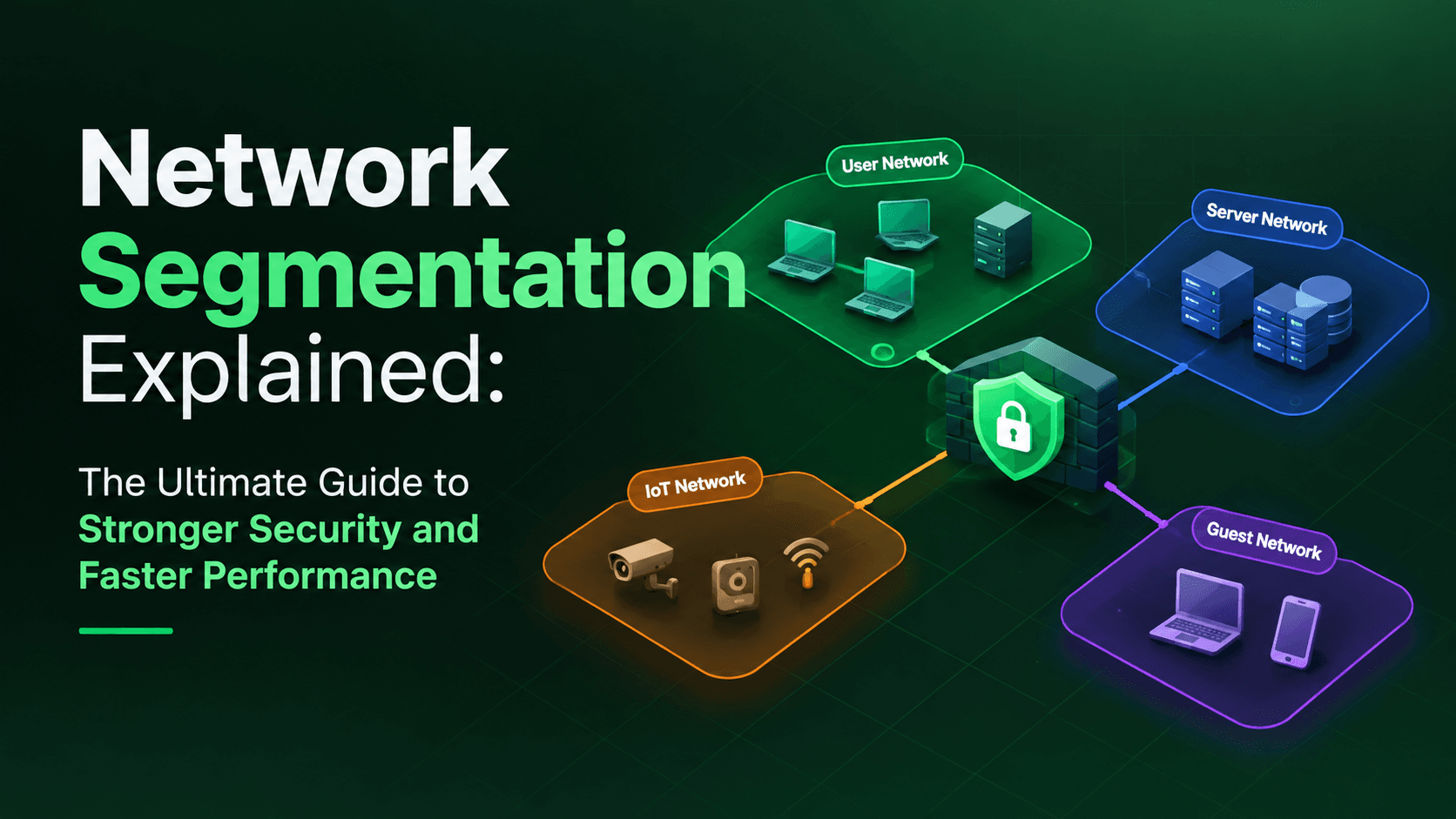
Network segmentation divides a single network into smaller, isolated zones to contain threats, reduce attack surfaces, and improve performance. Here's a practical, no-fluff guide to how it works, why it matters, and how to implement it the right way.
Network Segmentation Explained: The Ultimate Guide to Stronger Security and Faster Performance
Picture a office building with no interior walls or locked doors — just one giant open room. Anyone who gets past the front entrance has access to every desk, every filing cabinet, every server closet. That's what a flat, unsegmented network looks like to an attacker. One compromised laptop, one phished employee, one unpatched IoT device, and suddenly the intruder has a clear path to your entire digital infrastructure.
Network segmentation fixes this by building walls, doors, and checkpoints inside your network. Instead of one open room, you get a building with departments, hallways, and access control at every turn. It's one of the most effective — and most underused — strategies in modern IT security.
This guide breaks down what network segmentation actually is, why it matters more than ever in 2026, and how to implement it without turning your infrastructure into an unmanageable mess.
What Is Network Segmentation?
Network segmentation is the practice of dividing a computer network into smaller, distinct sub-networks (often called segments, zones, or subnets), each with its own security controls and access rules. Instead of treating your network as one continuous space, you break it into logical or physical sections based on function, sensitivity, or user group.
For example, a typical segmented network might separate:
Guest Wi-Fi from the corporate network entirely
Finance and HR systems from general employee workstations
IoT and smart devices (cameras, printers, sensors) into their own isolated zone
Production servers from development and testing environments
Point-of-sale systems from the rest of a retail network
Traffic between these segments is controlled by firewalls, access control lists (ACLs), or software-defined policies. A device in one segment can only reach another segment if there's an explicit rule allowing it — everything else is denied by default.
Why Network Segmentation Matters
1. It Limits the Blast Radius of a Breach
This is the single biggest reason organizations adopt segmentation. When a network is flat, a single compromised device can become a launchpad for lateral movement — attackers hopping from system to system until they find valuable data or critical infrastructure. Segmentation stops that lateral movement cold. If an attacker breaches the guest Wi-Fi, they hit a wall the moment they try to reach the finance servers.
2. It Supports Compliance Requirements
Regulations like PCI DSS, HIPAA, and GDPR often require organizations to isolate sensitive data — cardholder information, health records, personal data — from the rest of the network. Segmentation isn't just a best practice in these cases; it's frequently a legal requirement, and auditors will specifically check for it.
3. It Improves Network Performance
Segmentation isn't only about security. Splitting a large network into smaller broadcast domains reduces congestion, cuts down on unnecessary broadcast traffic, and makes troubleshooting far easier. A problem in one segment doesn't ripple out and slow down the entire organization.
4. It Makes Threat Detection Easier
Monitoring a smaller, well-defined segment is far simpler than watching an undifferentiated sea of traffic. Unusual activity — like a printer suddenly trying to talk to a database server — stands out immediately in a segmented environment, where it might get lost in the noise on a flat network.
5. It Reduces the Attack Surface for IoT and Legacy Devices
Smart devices, legacy systems, and third-party equipment are often the weakest links in a network because they can't run modern endpoint protection. Isolating them into their own segment means a vulnerability in a smart thermostat or an outdated legacy application doesn't automatically expose the rest of the business.
Types of Network Segmentation
Physical Segmentation
This involves separating networks using distinct physical hardware — separate switches, routers, and cabling for each segment. It offers the strongest isolation but is expensive, inflexible, and hard to scale, which is why most modern networks lean on logical methods instead.
VLAN Segmentation
Virtual Local Area Networks (VLANs) let you logically separate traffic on shared physical hardware. Devices on different VLANs can't communicate directly unless routed through a Layer 3 device with the right access rules. VLANs are affordable, well-supported, and remain one of the most common segmentation methods for small and mid-sized networks.
Firewall-Based Segmentation
Internal firewalls (not just perimeter firewalls) are placed between segments to inspect and filter traffic. This adds a strong layer of control and visibility, especially when combined with VLANs, since the firewall enforces exactly which traffic is allowed to cross segment boundaries.
Micro-Segmentation
This is the most granular approach, and it's rapidly becoming the standard for modern data centers and cloud environments. Instead of segmenting at the network level, micro-segmentation applies policies down to the individual workload or application level — often using software-defined networking (SDN) tools. Two servers sitting in the same rack, on the same subnet, can still be prevented from talking to each other unless explicitly permitted.
Zero Trust Segmentation
Closely related to micro-segmentation, zero trust takes the philosophy further: no device or user is trusted by default, regardless of whether it's inside or outside the traditional network perimeter. Every connection must be authenticated and authorized, every time. This model has become a cornerstone of modern cybersecurity strategy as remote work and cloud adoption have dissolved the old idea of a secure "inside" network.
How to Implement Network Segmentation: A Practical Roadmap
1. Map your network and classify assets. You can't segment what you don't understand. Start with a full inventory of devices, applications, and data flows. Classify assets by sensitivity and function — critical servers, employee devices, guest access, IoT, and so on.
2. Define segmentation zones based on business needs. Group assets that share similar risk profiles and access requirements. A common baseline is separating: internet-facing systems, internal corporate systems, sensitive data stores, and IoT/OT devices.
3. Apply the principle of least privilege. Every segment should only be able to reach exactly what it needs — nothing more. Default-deny should be the rule; explicit rules should be the exception.
4. Choose your segmentation technology. For smaller networks, VLANs plus a capable firewall are often enough. Larger or cloud-heavy environments benefit from SDN-based micro-segmentation tools that can enforce policy at the workload level.
5. Monitor and log traffic between segments. Segmentation is only as good as your visibility into it. Set up logging and alerting for traffic crossing segment boundaries so unusual patterns get flagged quickly.
6. Test and refine continuously. Run periodic penetration tests and access reviews. Networks evolve — new devices, new applications, new employees — and segmentation policies need to evolve with them.
Common Mistakes to Avoid
Over-segmenting too quickly. Trying to carve out dozens of micro-zones on day one usually creates a management nightmare. Start with broad, high-value segments and refine over time.
Forgetting about east-west traffic. Many teams focus heavily on perimeter defense and internet-facing rules while ignoring traffic that moves laterally inside the network — which is exactly where segmentation delivers the most value.
Neglecting documentation. Segmentation rules that live only in one administrator's head become a liability the moment that person leaves. Document every rule and the reasoning behind it.
Treating segmentation as a one-time project. Networks change constantly. Segmentation policy needs regular review, not a "set it and forget it" approach.
Final Thoughts
Network segmentation isn't a flashy technology, but it's one of the most impactful changes an organization can make to its security posture. It shrinks the attack surface, contains breaches before they spread, improves day-to-day performance, and gives IT teams far better visibility into what's actually happening on their network.
Whether you're a small business just starting with VLANs or an enterprise moving toward full zero trust micro-segmentation, the underlying principle stays the same: don't give every device a master key to the entire building. Build walls, add doors, and control who gets to walk through them.