
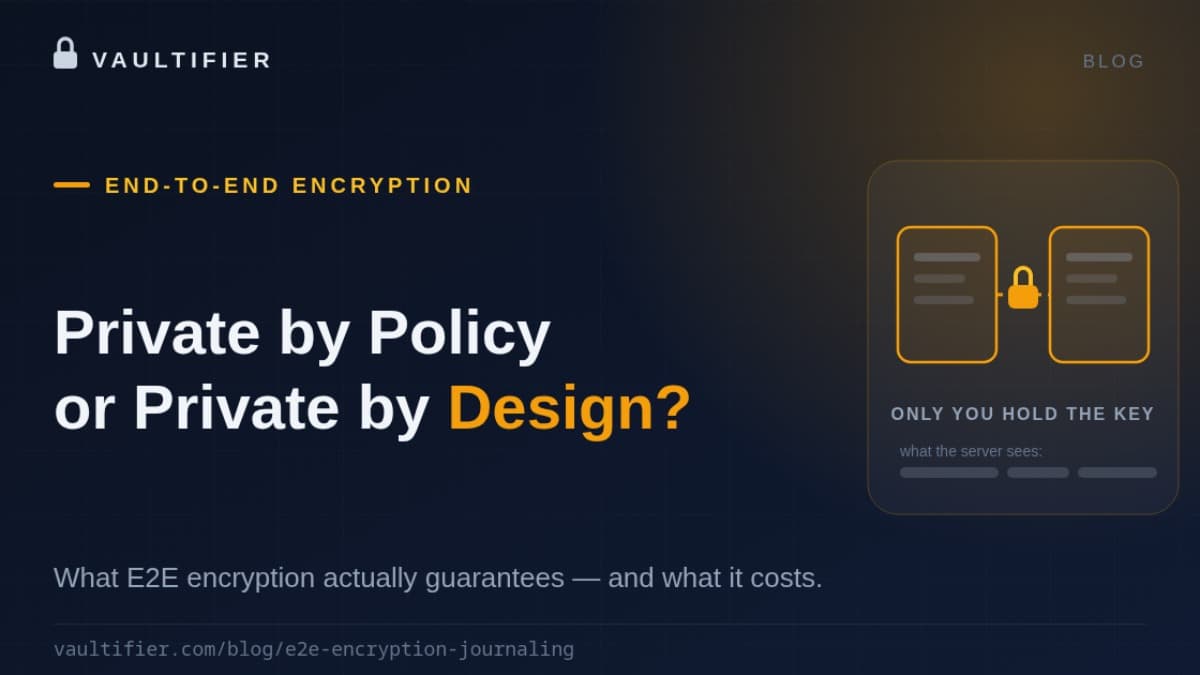
Why End-to-End Encryption Matters for Personal Writing
We accept a certain amount of exposure with most of our data. A shopping app knowing what you bought. A maps app knowing where you've been. It's uncomfortable in the abstract but rarely feels personal in the moment.
Diary and journal entries are different, and it's worth being specific about why — because "encryption matters" is true of almost everything digital, but it matters in a distinct way here.
Your diary is the one place you're not performing
Social media, messages, even private group chats — all of it carries some awareness of audience. You choose your words knowing someone will read them. A diary is often the only place where that filter comes off entirely: unfiltered anger at a partner, fear about your health, doubts about your career, grief you're not ready to say out loud to anyone.
That's precisely what makes it valuable as a writing practice — and precisely why it's the worst possible category of data to have exposed. A breach of your shopping history is annoying. A breach of years of your most unguarded thoughts is a different category of harm entirely.
"We won't look" is not the same as "we can't look"
Most privacy policies are promises about intent: the company says it won't read your data, won't sell it, won't share it without cause. Promises about intent are only as good as:
The company's current leadership and their priorities
Whichever government or legal system has jurisdiction over them
Whether they get acquired by a company with different values
Whether an employee with access decides to look anyway
Whether they get breached by someone who doesn't care about their policies at all
End-to-end (or zero-knowledge) encryption replaces a promise with a mathematical fact: even if every one of those circumstances changes, there's no readable data to hand over, sell, or leak — because the company was never holding the key that would decrypt it.
It protects you from the requests you can't foresee
People often think about diary privacy in terms of hackers. But some of the more realistic scenarios are more mundane:
A subpoena in a custody dispute, requesting "any relevant personal records"
A change in company ownership, and a new privacy policy that quietly changes what's allowed
An account compromise where someone resets your password and expects to find your history intact
A well-meaning support agent who has broader account access than they need
True end-to-end encryption doesn't require you to predict which of these might happen to you. It just makes the data unreadable regardless of who's asking or why.
The trade-off is real, and worth naming
End-to-end encryption isn't free. If your key is derived only from your password and never stored anywhere, forgetting that password means the entries are gone — there's no "verify your identity and we'll unlock it for you," because unlocking it isn't something the company can do either.
That's a genuine cost, not a footnote. It's why a well-designed journaling app treats this as a deliberate choice rather than forcing it on everyone: lighter, lower-stakes journaling might reasonably favor convenience, while anything you'd genuinely be devastated to have exposed is a strong candidate for the stricter mode, password recovery risk included.
What to actually look for
If end-to-end encryption matters to you for your own writing, the practical checklist is short:
Confirm the key is derived from something only you know (usually your password), not generated and stored by the server.
Confirm there's no password-reset flow that restores old entries — if there is, the company holds a key somewhere.
Confirm the encryption happens on your device (in-browser or in-app), not after your plaintext reaches their servers.
Personal writing is one of the few kinds of data where "no one else can read this, structurally" is worth the inconvenience of true responsibility for your own password. It's the difference between a diary that's private by policy and one that's private by design.